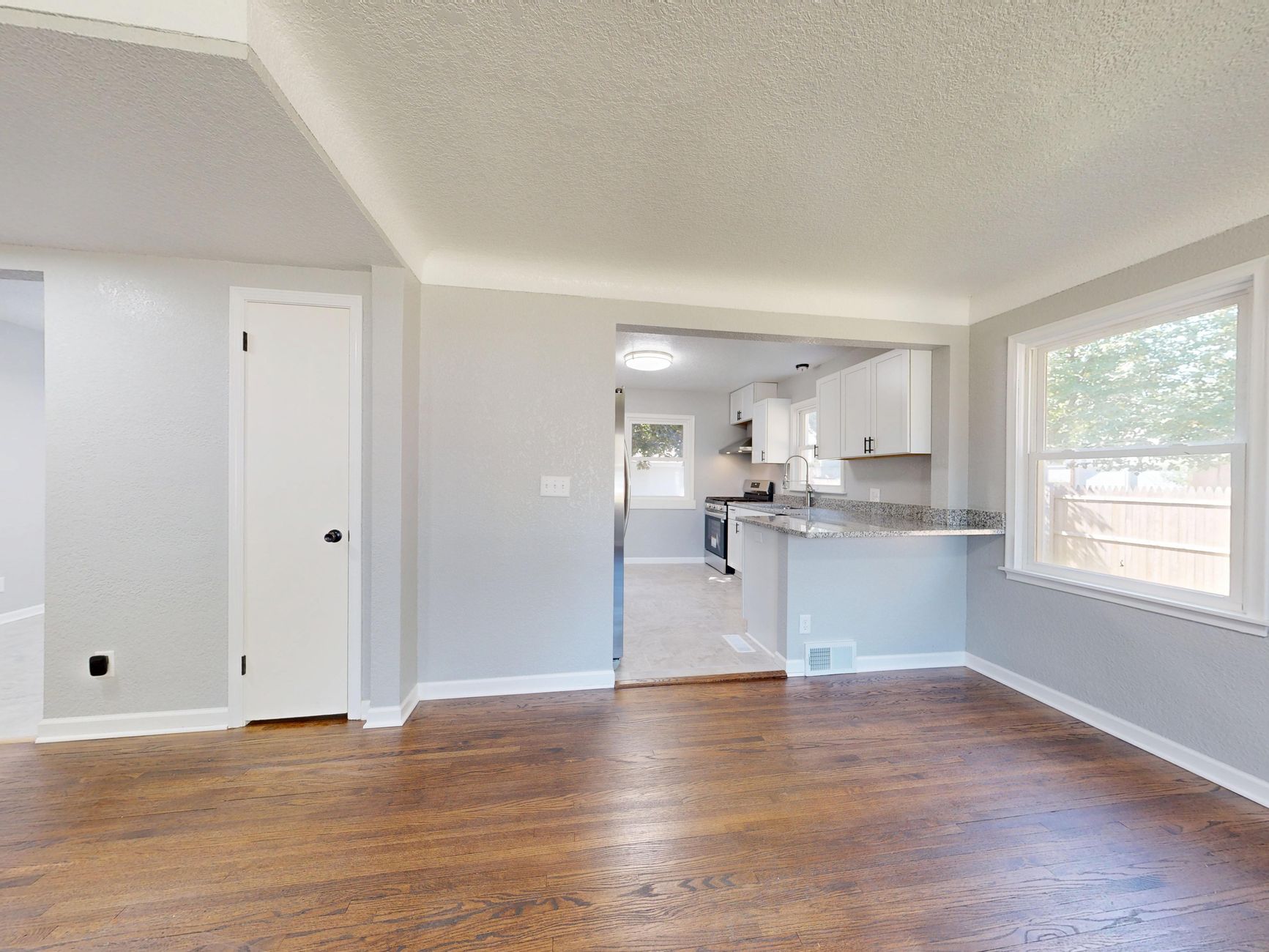
Refinishing Wood Floors in Oregon: Douglas Fir and What Is Under the Carpet
A quarter of Portland's houses were built before 1940, and in that era an Oregon floor was usually Douglas fir — which makes “what is already down there” the cheapest question you can ask before buying anything.
What it costs
Refinishing an existing wood floor in Oregon generally runs $3 to $9 per square foot — roughly a third of the cost of replacing it, and often less. The bottom of the band is a sand and two coats of waterborne finish on a floor in good order. The top is a floor that needs boards let in, nail holes filled, a stain and three coats.
An estimate, not a quote. These are planning ranges for Oregon, not a quote. What you actually pay depends on your rooms, your subfloor and the material you choose.
The Oregon floor is fir, and that changes the job
Oregon supplied the softwood that built the West, and it used it at home. In a house built here before about 1950, the original floor is far more likely to be vertical-grain Douglas fir than oak. It is usually 3-1/4 inches wide, tongue and groove, and it is very often still there under a later carpet or a layer of vinyl.
Fir is a softwood and the numbers say so: Douglas fir rates about 660 on the Janka hardness scale against red oak’s 1,290. But the fir in a 1912 Portland house is not the fir sold today. It came from trees that had been growing for centuries, so the growth rings are packed tight, and tight-ringed old-growth fir is considerably denser and harder than the fast-grown product that carries the same name. Judging a hundred-year-old fir floor by a modern hardness table underestimates it.
Why sanding fir is a specialist job
Douglas fir has a pronounced difference in density between its soft early wood and its hard late wood. A drum sander driven the way it would be on oak eats the soft bands faster than the hard ones, and the result is a washboard surface that only shows up under a low-angle light after the finish goes on. Ask an installer directly how many fir floors they have done. It is a fair question and the answer is informative.
The other constraint is thickness. An original 3/4-inch fir floor has a finite amount of wood above the tongue — usually enough for two or three full sands over its whole life, and some of that may already be spent. A floor that has been sanded three times is a candidate for a screen and recoat, not another aggressive pass.
Screen and recoat: the cheap option most quotes skip
If the finish is worn but the wood underneath is not damaged or stained, abrading the existing finish and applying one or two fresh coats costs a fraction of a full sand, takes a day, and removes no wood at all. It does not fix deep scratches, pet stains or color changes. It is frequently the right answer and it is worth asking for by name, because a quote for a full sand is worth several times as much to whoever wrote it.
Refinish or replace, by side of the state
This is genuinely a west-side question. Portland is 26.8% pre-1940 and Corvallis 8.0%, so the odds of an original floor are real. Bend is 4.2% pre-1940 with 52.0% of its housing built since 2000 — there is nothing under the carpet there but plywood, and refinishing is a question about a floor someone already chose rather than one about a floor you inherited.
Common questions
How do I find out what is under my carpet?
Lift a corner in a closet or behind a door with pliers. Tack strip pulls up with a pry bar and the carpet folds back. Ten minutes and a vacuum will tell you what species, what width and what condition, and it costs nothing.
Can a fir floor be stained dark?
It can, but fir takes stain unevenly for the same early-wood/late-wood reason that makes it hard to sand, and dark stain exaggerates the effect. A conditioner first, and a sample on a closet floor before committing to the whole room.
Is a floor with gaps a failed floor?
No. Seasonal gaps in a board floor are normal and mostly close again. Permanent gaps wide enough to lose things in are a filling question, and filling wide gaps in a floor that still moves is usually a mistake — the filler is what cracks.